
Mealybugs are one of my least favorite bugs to deal with on my houseplants.
They can be difficult to get rid of, and even after you think you’ve gotten them all, they can show up again.
Thankfully, there are many different methods you can use to get rid of them.
This post may contain affiliate links. That means if you click on them and buy something, I may receive a small commission. Read my Disclaimer Policy to learn more. As an Amazon Associate, I earn from qualifying purchases.
What are Mealybugs?
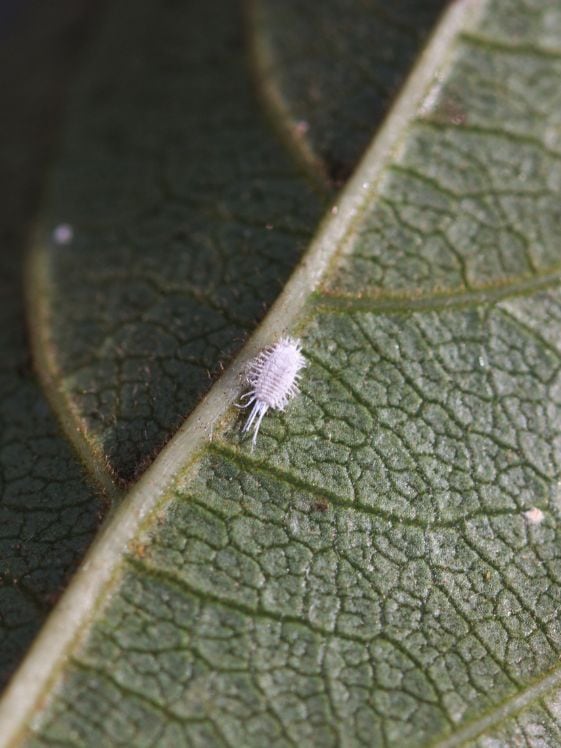
Mealybugs are soft-bodied insects, measuring only 1/20th to 1/5th of an inch in size.
They look white and fuzzy, but according to Wisconsin Horticulture they are actually pink. The whiteness comes from the cottony, waxy coating on their bodies.
These wingless insects are often found in clusters on the stems of leaves and plants, though I’ve found them individually on the top of the leaves as well.
Mealybugs can infest all parts of a plant, including the roots, which makes them harder to get rid of than other pests.
They are most common on tropical plants as they like the higher moisture these plants usually grow in, but they can be found on any plant in your house.
How Do Mealybugs Damage Plants?
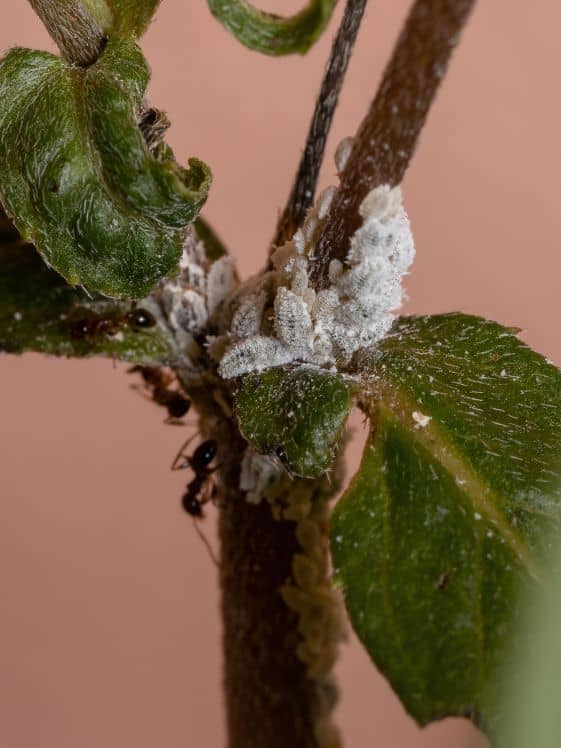
Mealybugs damage plants by feeding on their sap.
This weakens the plant and can even kill it if the mealybug infestation is left unchecked.
They also leave a sticky substance called honeydew on the leaves.
Honeydew can then attract sooty mold, which, in large quantities, can limit the plant’s ability to photosynthesize, causing further plant damage.
Signs of Mealybugs
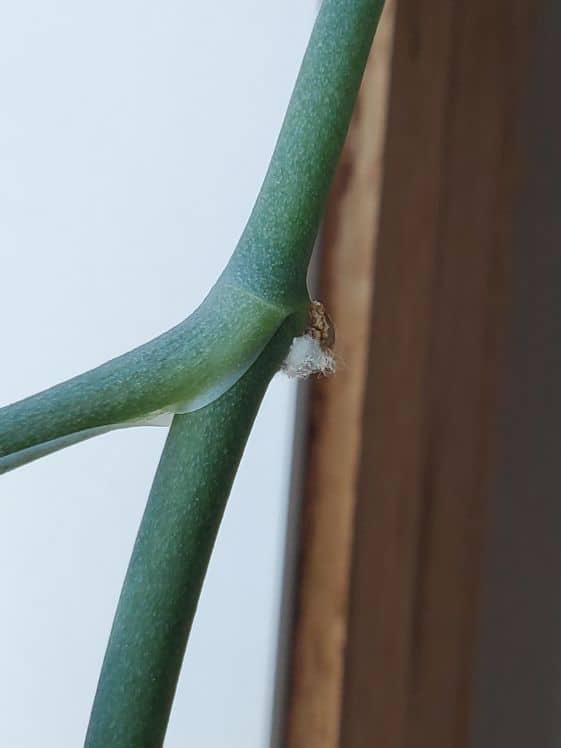
There are several signs to look for when deciding if you have a mealybug infestation or not.
These signs are:
- White cottony masses on leaves and stems
- Sticky residue on leaves (this is called honeydew)
- Yellowing leaves or brown spots
- Leaves dropping off
- Plant growth slowing down or stopping
How to Get Rid of Mealybugs on Houseplants?
There are several different methods you can use to get rid of mealybugs.
Choose the one that works best for you.
Prune Heavily Infested Areas
To help improve your chances with the methods below, start by pruning away heavily infested leaves or stems.
This can help the treatment work by limiting the number of mealybugs actively on your plant.
Neem Oil
Neem oil is a naturally occurring insecticide that can kill and repel many types of plant pests, including mealybugs.
To use neem oil, mix two to four Tbsp of neem oil concentrate with one gallon of water.
Please double-check the measurements on your bottle of neem oil concentrate, as they could be different than the directions on my bottle.
Make sure to mix it thoroughly and pour it into a spray bottle.
Spray it on all parts of the plant, making sure to also get the undersides of leaves.
Do not apply in direct sunlight, or it may burn your plants.
I recommend keeping your plants out of direct sunlight until the neem oil is dry.
Neem oil has a residual effect, so you don’t need to apply it daily.
It does, however, need to be reapplied weekly for at least 3 weeks or until there are no more signs of mealybugs.
I’ve heard several complaints from people who say
I’ve heard several complaints from people who say neem oil doesn’t work on plant pests, but it’s always been my go-to product.
The biggest issue is that you have to reapply it. If you don’t reapply it, the bugs will come back.
The only time neem oil didn’t work for me was when I forgot to reapply it.
Insecticidal Soap
Insecticidal soap is another safe and effective way to get rid of mealybugs on houseplants.
The nice thing about insecticidal soap is that several ready-to-use options are available, making treatment convenient.
All you do is spray the plant, making sure to hit all sides of the leaves and stems.
The mealybugs will die within a few hours of exposure.
Repeat every 7 days as needed, monitoring for any new signs of infestation.
Isopropyl Alcohol Cotton Swab Method
Isopropyl alcohol, also known as rubbing alcohol, can be used to kill mealybugs on contact.
Just take a cotton swab dipped in 70% isopropyl alcohol and touch it to each mealybug you see.
If you don’t have any cotton swabs, you can also use a cotton ball; just be careful to touch as little of the plant as possible.
According to SFGate, the alcohol dissolves the protective outer coating of mealybugs and their eggs and kills them.
This is a time-consuming method, but it works quite well on light infestations and has less chance of damaging your plants.
Horticultural Oil
Horticultural oil is another nonchemical method to get rid of mealybugs.
It works by smothering the mealybugs.
To use this method, mix the horticultural oil with water according to the directions on the bottle.
Or buy a premixed, ready-to-use variety of it.
Whether you mix your own or buy premixed, pour the mixture into a spray bottle and thoroughly drench the plant, making sure to get the entire plant.
Repeat as directed on the bottle.
One warning: some plants can be sensitive to horticultural oil.
To find out if your plant is sensitive, apply it to a couple of leaves and check on it in 24 hours.
If you see signs of stress, use a different method.
Toss the plant
This is the most extreme option, but if you aren’t attached to the plant and don’t want the stress of repeated applications, this may be the best option.
Take the plant, put it in a bag, and put it in your garbage can. Pot, dirt, and all.
I use this option as a last resort. If my plant is on death’s door, it isn’t worth trying to save.
At that point, the treatment itself may cause it to die.
Tossing the pot is not required, but tossing the dirt is essential, as they can live in the dirt as well.
If you keep the pot, give it a good washing with bleach to kill anything that may still be in the pot.
Other Methods That I Wouldn’t Try
Here are a few methods that could work, but I’m not willing to try them on my plants.
Wash Mealybugs Away with Water
This is one of the simplest ways to get rid of mealybugs.
All you do is spray the plant with a strong stream of water in the hopes of blasting the mealybugs off the plant.
The upside of this method is that it removes pests fast, preventing further harm.
However, I avoid using this approach alone because it doesn’t address mealybugs in the soil or on parts of the plant unreachable by water.
It also increases the risk of spreading the mealybugs to other plants unless you do it outside. And for me, that’s not an option half the year, as it’s just too cold outside for my indoor plants.
Plus, a strong stream of water can damage some plants just as much as the mealybugs.
Homemade Soap Spray Method
Mixing 1 quart of water with 1 teaspoon of dish soap or pure Castille soap creates a spray that can kill mealybugs on contact.
You apply it by spraying both sides of the leaves and stem, repeating every 7 days until the pests disappear.
I don’t use this method because soap can break down the natural oils on plant leaves.
While occasional use might not cause harm, the risk of plant damage isn’t worth it when safer options exist.
Isopropyl Alcohol Spray Method
This method involves spraying houseplants with a mix of isopropyl alcohol and water, covering every inch, including leaf undersides, stems, and branch joints.
The treatment is repeated weekly for about a month.
My main concerns are the lack of clear guidance on the ideal isopropyl alcohol to water ratio, which can range from one cup to equal parts, and the fact that isopropyl alcohol can cause significant plant damage if too strong.
Because of this risk, I prefer not to use this method.
Beneficial Insects
Beneficial insects are natural predators of the pest you are trying to get rid of.
For mealybugs, the most common are ladybugs and green lacewings.
There is a specific type of ladybug, the mealybug destroyer (Cryptolaemus montrouzieri), or mealybug ladybird, that is especially good at eating mealybugs.
You can purchase these insects online or at a garden center.
Once you have them, release them near the infested plant, making sure to follow the package directions.
I really like this method, in theory.
I just can’t get past the idea of letting bugs loose in my house, even if they are good bugs.
If that doesn’t bother you, give it a shot.
Chemical Pesticide
Finally, chemical pesticides are another option, but I avoid them.
If you choose this route, pick a product that specifically targets mealybugs and carefully follow the application directions.
Although effective when used properly, many chemical pesticides pose risks, especially around children and pets, which is a major concern for my household.
How to Prevent Mealybugs from Coming Back
Once you have eliminated the mealybugs in your plants, you will want to take steps to prevent mealybugs from infesting your plants again in the future.
There are a few important measures that will help with this.
Quarantine and Inspect New Plants
The number one way that I’ve gotten mealybugs in my home is by bringing in new plants.
To prevent mealybugs from spreading in your home, quarantine all new plants.
Keep them away from all other plants until you are sure they don’t have any bugs.
While the plant is in quarantine, inspect it for mealybugs and other common houseplant pests.
If you find any, treat that plant before putting it with your other plants.
The downside is that it can take a few weeks or even months to be certain the plant is free of any hitchhikers.
Systemic Insecticide
Systemic insecticides are a powerful preventative measure.
They are applied to the soil and absorbed by the plant.
These protect your plants by poisoning the bugs when they feed on the plant’s sap.
Be sure to follow the directions on the systemic insecticide you have for correct application.
With proper use, this type of insecticide can protect your plants for several months.
However, similar to chemical pesticides, there is a risk of plant damage and safety concerns when using systemic insecticides around pets and children.
If you have pets that may snack on your plants, sometimes it may be safer to tolerate a few pests rather than risk plant damage or exposure to harmful chemicals.
Don’t Overwater
Mealybugs prefer to live in moist environments.
By not overwatering your plants, you will create an environment that is less inviting for them.
It’s also better for your plants if you don’t overwater them, as overwatering can cause issues of its own.
Final thoughts
Mealybugs may be persistent pests, but with the right approach, you can successfully get rid of them and keep your houseplants healthy.
Regular inspections, prompt action, and treating at the first sign of a mealybug can all help prevent infestations from spreading.
Remember to isolate affected plants during treatment.
With diligence and patience, your plants will stay pest-free and thriving!